By: Paige Valentik MPS, RD, LDN
There are countless diet plans out there that promise fast weight loss. I can’t argue that they work; most of them do truly result in weight loss. BUT rarely for the long term. It’s not impossible, but it’s rare. Let’s simplify weight management and bring it back to the basics: take in fewer calories than you burn.
First, let’s go over the super basics. Calories are fuel for your body. Your body has a constant demand for energy and uses the calories (energy) from food to keep you going. Carbohydrates, fats and proteins are macronutrients that contain calories. They are your body’s main energy sources. No matter what type of macronutrient, the calories you eat are either used for energy/another bodily function or stored in the form of body fat. So, you can either consume the correct amount of calories your body needs, consume less than your body needs (requiring your body to draw from its reserves) or consume more than your body needs resulting in excess storage/weight gain.
A well-known rule-of-thumb is the 3,500 calorie rule. Past research has shown that 3,500 calories is equal to 1 pound of body fat. Researchers then recommended burning or cutting 500 calories per day to result in 1 pound of weight loss per week. This is a very simplified and generalized recommendation. Please know that it is not that straight forward. While you may lose 1 pound per week, I cannot guarantee you will lose exactly 1 pound per week by doing this. Everyone is different and has different requirements when it comes to nutrition related goals such as this. This is why whenever I am asked a nutrition question my response is almost always “it depends”. I need a lot more information from someone to be able to help them lose weight, then just simply tell them to eat or burn 500 additional calories per day. I’m just throwing it out there: meet with a Registered Dietitian for individualized recommendations and help!
Here we go with bringing it back to the basics. To lose weight, you need to burn or cut out more calories than your body requires. Physical activity is always a great option. If you missed John’s article from last week about cardiovascular training, read it here for some ideas. From a nutrition point of view, take a look at your portion sizes. As I spent this week drafting and writing this article I decided to take a look at mine. Long story short: I have been overeating. Not every meal or every snack, but when I took the time to measure out proper portions I found that I have been low grade overeating multiple times a week. No wonder my postpartum progress has been slow (among other reasons, of course).
A classic, old school trick to help with portions is to use a smaller plate or bowl. I wish I had some brand new idea that I came up with, but I don’t because this is another example of how bringing it back to the basics goes a long way. I measured out a proper portion of cereal (1 cup) and ouch, I’m eating at least 1½ to 2 cups whenever I eat cereal. I also measured out a proper portion of mashed potatoes (½ cup) and yup, I’m eating at least 1 cup each time. These portions are smaller than I felt I “needed” in the moment, but I was pleasantly full when finishing, so I felt a huge sense of accomplishment. But, I want to show you how by using a smaller plate and a smaller bowl, my mind thinks I’m eating more. See the pictures below…(Shout out to John for making the meatloaf on his “Daddy Dinner” night.)
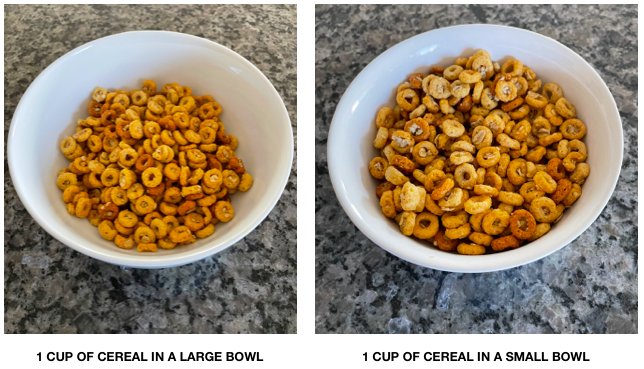
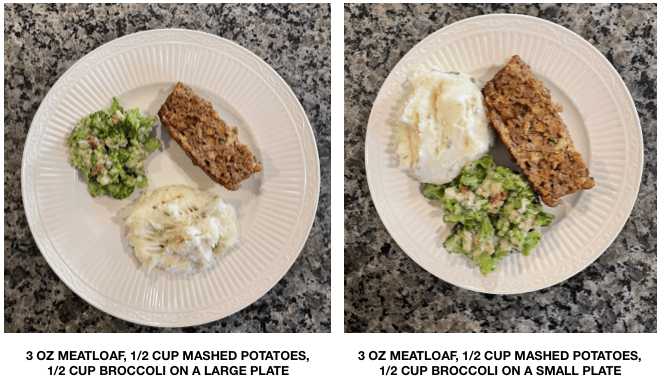
Give it a try and see what you think. I would also recommend taking the time to measure out proper portions of a few of your “go-to’s” to see if you’re overeating occasionally like me!


Leave a Reply